Authority from a free place

Every now and then I have conversation about authority with friends of mine who are anarchists - or even, in their own words, anti-authoritarians.
With such a central concept, you would think people would have a clear definition of authority. In my experience, instead we often find a lot of ambiguity and contradiction around authority. If the concept is central to the understanding and practice of anarchy, we would do well to clear it up a bit.
The people who call themselves anti-authoritarians or anarchists come in many shapes, but the words are used more or less synonymously. I've never met anyone who said they thought of themselves as only one of those, but not the other.
I sometimes call myself an anarchist, but I'm not so sure about anti-authoritarian. This is my starting point. I seem to be different from many of my anarchist friends. I have asked them what they mean, when they talk about authority. Here's what I've learned so far.
The authority of skill and experience
On the one hand, my anti-authoritarian friends are against authority. On the other hand, if you ask them about it, they are not against all forms of authority, e.g. the authority of the shoe-maker.
That's a hat tip to an oft-quoted passage in Bakunin's God and the State:
Does it follow that I reject all authority? Far from me such a thought. In the matter of boots, I refer to the authority of the bootmaker; concerning houses, canals, or railroads, I consult that of the architect or the engineer. For such or such special knowledge I apply to such or such a savant. But I allow neither the bootmaker nor the architect nor savant to impose his authority upon me. I listen to them freely and with all the respect merited by their intelligence, their character, their knowledge, reserving always my incontestable right of criticism and censure.
This is the authority of skill and experience. We listen to people with that kind of authority, because they're likely to have valuable insight within their domain.
So it seems my anti-authoritarian friends are not against authority in total, but only certain kinds.
Which kinds?
Hierarchy or coercion
Well, the police, the state, the military, perhaps the school teacher too, representatives of the church, the patriarch, the cult leader and so on.
How do you then distinguish between the two kinds of authority?
From the point of view of my anti-authoritarian friends, the shoe-maker and the cop do have something in common - authority. One of them benign and legitimate, the other not.
My anti-authoritarian friends usually give me two kinds of responses here.
The first is: Well the latter form is a representative of a hierarchical organisation (like the church, military etc). The other not (the shoe-makers just represent themselves - perhaps their trade).
That does distinguish them somewhat. But as you might have noticed, it also shifts the problem.
What we learn is that the problem is not authority per se, but hierarchy. Why not just say you're against hierarchy then? What's the problem with authority?
The second response is similar: The difference between the authority of the shoe-maker and the cop is that the latter uses coercion, violence and force.
Again, the problem is not authority, but other things (coercion) that I find very reasonable to work against. I also don't like coercion and people being hit with a baton if they don't do as they're told.
What does coercion have to do with authority? My anarchist friends do not have good answers to this question.
Authority issues
Today, I found this slogan online. This sums up my biggest beef with other anarchists. So happy to have found it spelled out so clearly!
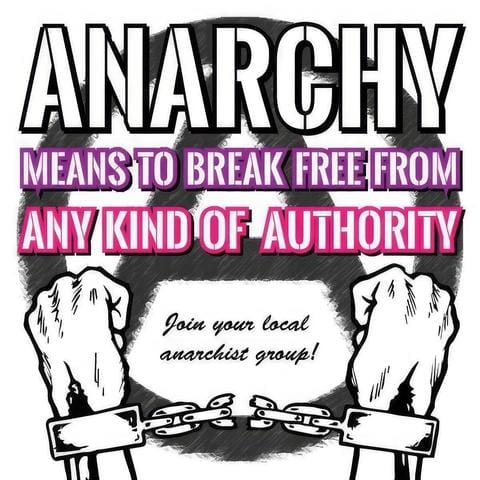
I could phrase my position in different ways. I'll try one that is close to the slogan here. In my world, anarchy means to break from our compliance to and defiance against external authority by taking up our own authority - and creating structures that help everyone do the same.
The confusion around authority is one of the main barriers for spreading anarchy and getting authority right for everyone is a solution to it.
Another way to say this in terms more close to many anarchists is empowerment. That's authority.
I think any political tradition has conceptual problems which it gets confused and which is also at the core of its promise. Authority is that core for anarchists. If we solve that issue in practice, we will win. Getting the words right is not solving the issue. But to clear up our misunderstanding of the concept is a good first step. Solving the issue means solving our authority issues - our difficulties accepting or own power and our hatred of being dependent on other people (incl. people we deeply dislike).
Other similar terms that I would say are different versions of authority is power-to, power-from-within and power-together. That's authority.
Working definition of authority
Here's my working definition of authority: The test whether something has authority is whether it is able to change the direction of where the energy is currently going.
Energy here could be anything people are doing, saying or focusing on. Of course you can force people to do, say or focus on things even if they secretly (or explicitly) resent you. Illegitimate authority exists.
But there's also the authority of inspiring action - when we follow along someone who got something right. The one who breaks the silence around a taboo and creates space for others to speak up too - that's inspiring authority in action. Anyone who decides to do something differently that then catches on shows authority.
When we shut up and listen (from a free place!) because an older and more experienced person finally speaks in a group of beginners - that's legitimate authority. That person probably has useful input if we decide to give space and listen. If we want power from below, this is exactly the kind of giving and taking of authority we should cultivate.
Authority is for giving and taking
It's important to remember that any legitimate authority can be taken away - it's dependent on others giving it. In fact, it's at the core of legitimate authority.
Think of the authority of a conductor. My uncle used to play in an internationally renowned orchestra and once told me that from time to time a guest conductor would come along that didn't have an appropriate attunement to the music they would play. What did the orchestra do? They politely, but collectively ignored the conductor. The conductor saved face and could be at at the center of the stage and the orchestra could get on with business. The very act of ignoring the conductor strips away the authority that is up to the orchestra to give. The musicians makes do with what they know, ie. take authority.
Does this mean that the ideal is to have orchestras play without a conductor. No! The ideal is to have a conductor that's in tune and can guide the orchestra as a whole - someone that the musicians willingly give authority, because they can see it makes everyone play better together.
The same applies to all the other examples. An "older and more experienced" person that no one cares to listen to by definition has no authority. It doesn't matter if they're right. Authority is not synonymous with being right. It's being able to change the direction of where the energy is going - influencing what other people do, say or focus on. What's right and what's true is obviously one important criteria for who we give authority. But it's not the only one.
Authority from a free place
The fact is that the world is full of people who are sitting on tremendously valuable information, experience and skill that the world around them couldn't care less about. They have little to no authority. The world misses out for that reason. The sense of having little to no authority in the world is at the heart of the common experience of humiliation. We feel ashamed of our own power.
The irony is that anarchists have so many issues with illegitimate authority from above (dominance) that many anarchists end up compulsively rebelling and resisting any kind of authority - even potentially legitime ones.
And no, if the rebellion is compulsive, it's not from a free place. Compulsions like that likely means you're fighting your own ghosts or your own inner potential for authority.
In Danish, out of several possiblities, you can also translate authority into the germanic myndighed. When young people become old enough to make their own decisions independently from their parents or caretakers (who used to have all the authority), we say that they've become myndige, or reached the age of their own authority (myndighedsalderen).
There's a parallel developmental track to explore here where one could see many of the problems in our society as having to do with our relative inability to grow up, that is, to psychologically and spiritually transition from adolescence to adulthood. That most of us seem to not develop a deeper sense of myndighed.
To just take one more example: There's a special kind of leadership in being the first to follow. In these times, where the good life seems to be about who has the most "influence", we sometimes forget the power in being a follower. It takes courage in giving someone authority when no one else does.
You can't have that courage if you're filled up with authority issues.
In the giving and taking of authority lies a promise for a different sense of freedom. Anyone else would like to explore what freedom would mean if we were free of our authority issues?
This text draws on conclusions I came to in a thesis written around 2016 with the title Fragments of an ungovernable psychology speculating among other things about the psychological dimensions of government, democracy in the pre-1850s sense, formal and informal consensus, charisma, sovereignty, coercion, the good life and authority.